
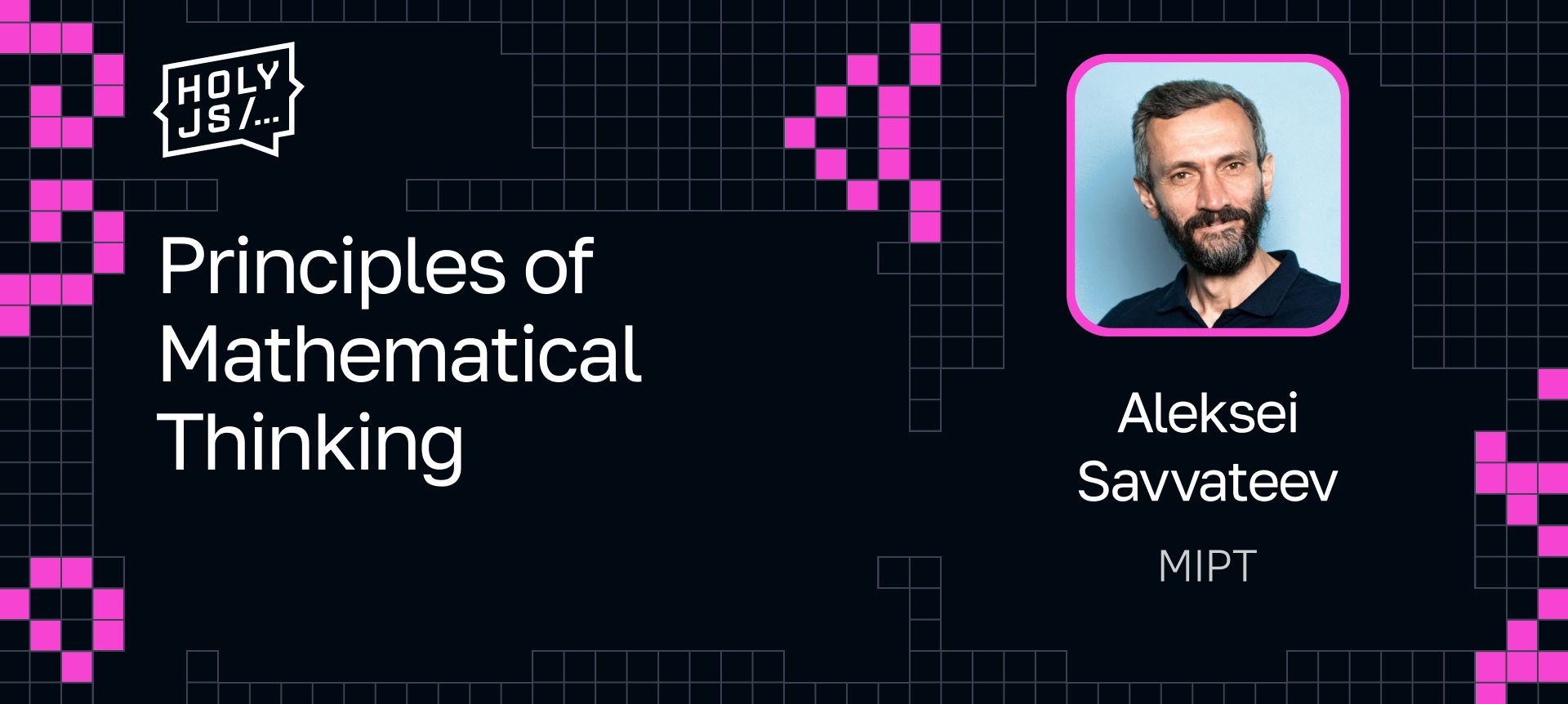
Mathematics as the Language of the World According to Savvateev
Mathematics may seem far removed from real life, but as Alexey Savvateev emphasizes, it is impossible to understand how our world works without it. It lies at the foundation of technology, algorithmic logic, and in general any interaction with reality. According to him, mathematics is unnecessary only for people whose profession relies entirely on inspiration, such as poets, artists, or singers. For everyone who interacts with the material world, it is essential, even if this is not consciously realized. An athlete running an ultra distance must be able to estimate their pace without gadgets, and a designer, no matter how much they resist it, inevitably works with geometry and proportions.
Savvateev is convinced that fundamental mathematics is still important. Without understanding its basics, it is impossible to use modern algorithms meaningfully, since they rely on logic developed back in the time of Newton, Leibniz, and Euler. The idea that today the main skill is learning quickly and that knowledge itself does not matter much seems mistaken to him. Without a solid foundation, the very ability to learn cannot be sustained.
He compares mathematics to a huge building with an infinite number of floors. The first floor is connected with understanding numbers themselves, the second with the appearance of unknowns and the ability to work with equations, and the third with abstract structures such as groups and fields. Higher up begin disciplines studied by very few people, such as homology or category theory, and then levels accessible, as Savvateev jokes, only to holders of the Fields Medal. Mathematics does not give instant rewards. After each completed level, a new one opens up, and this is where its special charm lies.
At the same time, beauty, in Savvateev’s view, is not reduced to formulas. He considers the famous golden ratio overrated, because true beauty is unpredictable and does not fit into strict models. Mathematics can explain many things, but not creative impulse or taste.
Even the school curriculum contains unsolved mysteries. For example, it is still unknown whether there are infinitely many pairs of twin primes, such as seventeen and nineteen or one hundred one and one hundred three. The problem looks simple, yet humanity has still not found an answer.
Savvateev believes that predicting the future with the help of models is only partially possible. Physical processes are described quite well, but when moving to biology or the social sciences, the accuracy of formulas rapidly decreases. Society cannot be fully calculated, because people change their behavior as soon as they learn the rules of the game. And this, according to him, is a good thing, since a completely predictable world would be unbearable.
He calls mathematics the language of nature, but not a universal tool applicable to everything. In human relationships it is useless, and any attempt to express family life through calculations will fail.
He considers it meaningless to talk about the future of mathematics within five or ten years, because its development takes entire centuries. Sometimes breakthroughs occur, such as the proofs of Fermat’s theorem or the Poincare conjecture, but in technology, in his opinion, we have long been living in an era of gradual improvements rather than great discoveries.
For those who want to become comfortable with mathematics, Savvateev advises starting with popular introductory books, such as his own Mathematics for the Humanities, the works of Courant and Robbins, or books by Ian Stewart. After that, one should move forward more boldly, because mathematics favors those who dare to climb higher and higher.