
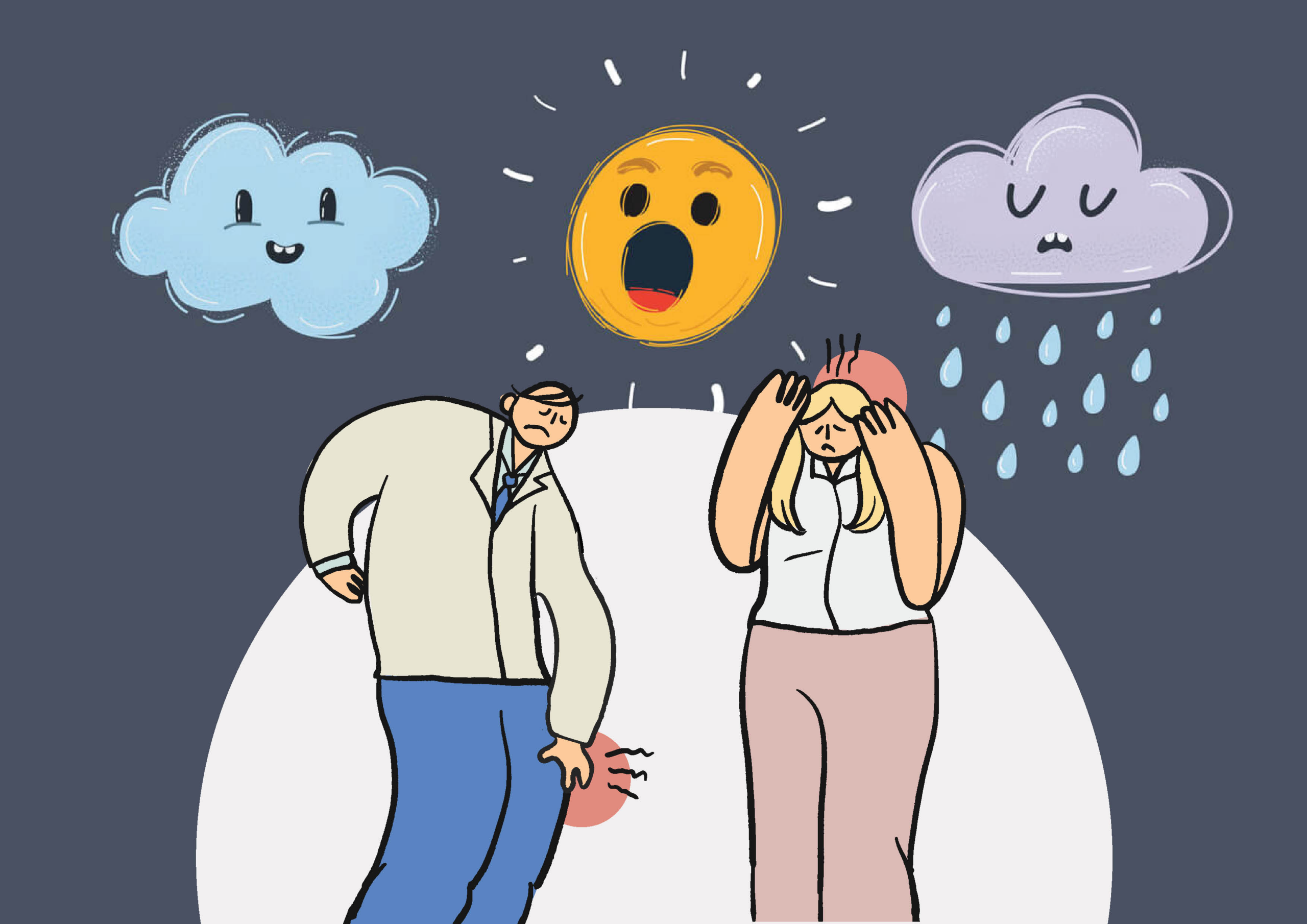
Weather Sensitivity: What It Is and Why It Happens
Many people notice that their well being changes sharply with the weather. It may start raining or suddenly become warmer, and the body immediately reacts with changes in blood pressure, migraines, or a feeling of weakness. This sensitivity to weather is called weather dependence. Although it is not considered a disease, it can significantly reduce quality of life.
Our bodies constantly adapt to the environment. When it gets colder, blood vessels constrict and blood thickens, causing pressure to rise. In hot weather, the opposite occurs: pressure drops and fatigue appears. Low atmospheric pressure or high humidity often causes joint pain. Sudden changes in solar activity can disrupt heart rhythm and affect breathing.
Some elderly people can easily predict rain because their knees or lower back start to ache beforehand. Others complain of severe fatigue and dizziness in hot weather when pressure drops.
It is important to understand that the weather itself does not cause disease. It only exacerbates existing problems with the heart, blood vessels, or joints and makes symptoms more noticeable.
Why do some people react strongly to climate changes while others feel almost nothing? It depends on how effectively the body’s adaptation system works. For some, it functions perfectly, so temperature fluctuations go almost unnoticed. For others, especially older people and those with chronic conditions, the reaction is much stronger. Women also report weather sensitivity more often, which is linked to hormonal factors.
There is no universal way to completely eliminate weather sensitivity. However, it is possible to ease the condition. Headache or joint pain can be relieved with standard anti inflammatory drugs, and blood pressure fluctuations require medications prescribed by a doctor. If alarming symptoms appear, such as severe chest pain or a sudden spike in pressure, immediate medical attention is necessary.