
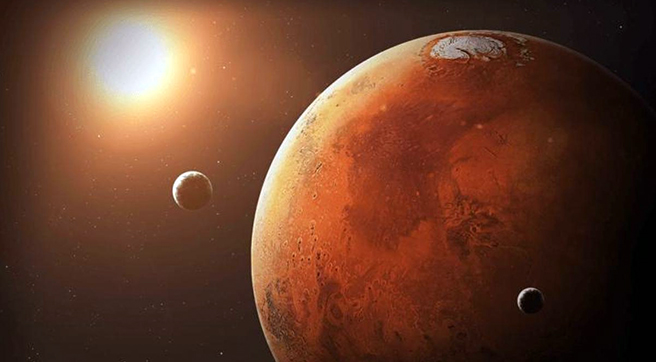
Mars as the Next Stage of Human Development
Colonizing Mars sounds like science fiction, yet this idea is being seriously discussed by scientists and space agencies. Mars is considered the closest candidate for a second habitable planet. It is relatively nearby, has a solid surface, a day length very similar to Earth’s, and enormous scientific value. Exploring it could become an important step toward the long term survival of human civilization.
The path toward this goal began long ago. In the nineteen sixties and seventies, the Soviet Union sent a series of automatic stations to Mars. Mars One flew past the planet, Mars Two crashed during landing, and Mars Three became the first in history to land softly on the surface but stopped transmitting data after only a few seconds, likely due to a powerful dust storm. The orbital modules of these missions still sent back large amounts of information about the planet. Later came Mars Four, Mars Five, Mars Six, Mars Seven, and the Phobos project, which studied the atmosphere, surface, near Mars space, and the moon Phobos. Attempts in the nineteen nineties and two thousands, such as Mars Ninety Six and Phobos Grunt, ended in failure. The joint ExoMars program with the European Space Agency, including the Kazachok platform and a rover, was halted for political reasons, and the future of Russian participation in Mars research remains uncertain.
Creating a permanent human settlement on Mars is incomparably more difficult than sending an automated probe. The journey takes six to eight months in a confined space under constant exposure to cosmic radiation. On the surface of Mars, gravity is about half that of Earth, the atmosphere consists almost entirely of carbon dioxide, temperatures fluctuate sharply, and dust storms are frequent. The planet lacks a magnetic field, which means the surface is poorly protected from radiation. All of this poses serious risks to both equipment and the human body.
For a Martian colony to exist, reliable life support systems must be created. These include protection from radiation, energy sources, and ways to obtain water, air, and food locally rather than delivering everything from Earth. People would have to live and work in isolation, far from home, knowing that returning might be impossible for a long time. Psychological pressure in such conditions would be no less severe than the physical strain. Added to this is the enormous cost of the project. Developing rockets, spacecraft, landing systems, and infrastructure on Mars requires vast resources.
Despite these challenges, humanity is actively preparing for future exploration of the planet. Rovers and orbiters continue to study Mars, testing landing technologies, autonomous operation, water detection, and the search for possible signs of life. Private companies such as SpaceX are building super heavy launch vehicles and openly declaring their intention to send the first humans to Mars in the coming decades. Even today, there are many volunteers willing to take the risk for such a mission.
Colonizing Mars is a real possibility, but it demands immense time and effort. It will not be a quick relocation, nor will it be limited to growing vegetables in Martian soil. Most likely, small research bases will appear first, followed gradually by stable settlements. And if humanity manages to overcome the technical, medical, psychological, and financial challenges, Mars may truly become the first step toward turning humans into a multi planetary species.