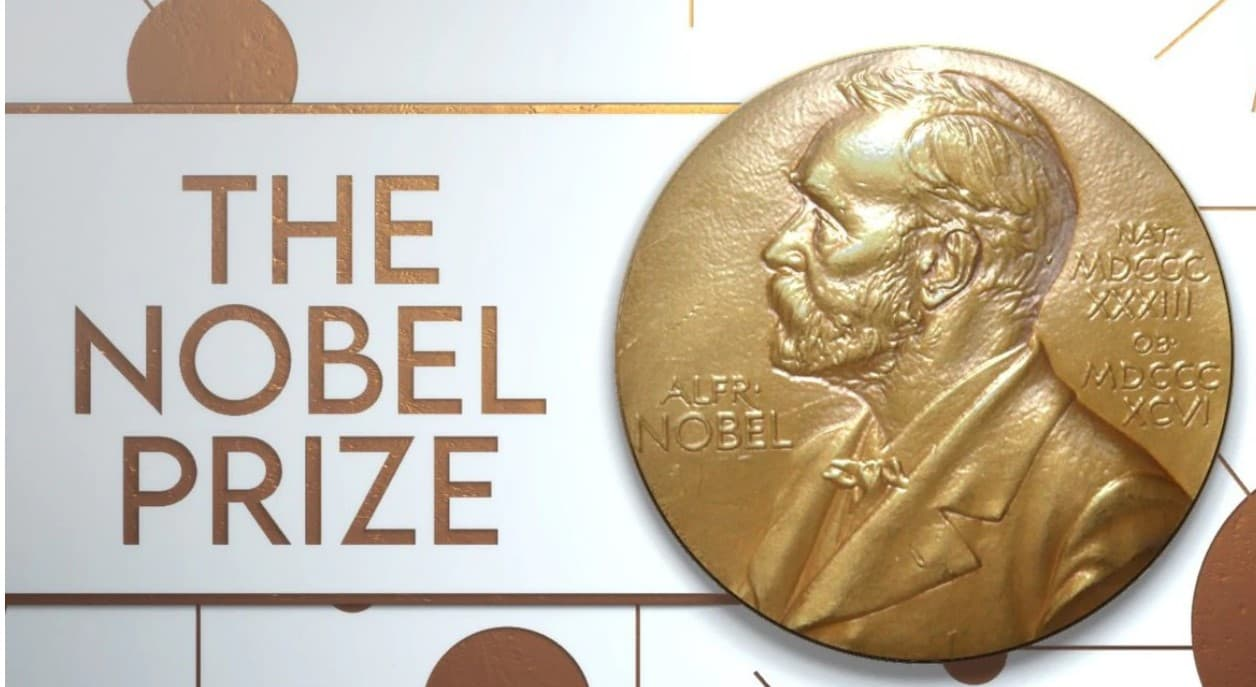
The Nobel Prize 2025
From October 6 to 10, the Nobel Committee announced the names of the laureates of the world’s most prestigious scientific and humanitarian awards, and on October 13 the recipients of the Sveriges Riksbank Prize in Economic Sciences in Memory of Alfred Nobel were revealed. The award ceremony will take place on December 10, the anniversary of Alfred Nobel’s death. The central theme of this year’s Nobel Week was the concept of resistance: resistance of the immune system to self destruction, resistance of materials to electric current, resistance of chemical structures to toxic gases, resistance of an artist to fear in times of crisis, resistance of an opposition figure to dictatorship, and resistance of economists to poverty and stagnation.
Physiology or Medicine
The prize was awarded to Mary Brunkow from the Institute for Systems Biology in Seattle, Fred Ramsdell from Sonoma Biotherapeutics, and Shimon Sakaguchi from Osaka University. They were recognized for their discoveries in the field of peripheral immune tolerance. The scientists studied how the immune system distinguishes dangerous viruses and bacteria from the body’s own cells, and why T lymphocytes sometimes mistakenly attack healthy tissues. Regulatory T cells suppress such errors and prevent autoimmune diseases. The laureates’ work opens new possibilities for the treatment of cancer and immune related disorders.
Physics
The prize went to John Clarke, Michel Devoret, and John Martinis for demonstrating quantum mechanical tunneling in a large scale electrical system and for showing energy quantization in a circuit. Previously, superconductivity and tunneling had only been observed at the microscopic level. The researchers were the first to demonstrate these effects in a system visible to the naked eye. Their work is crucial for the development of quantum computers and high precision measurement devices. Superconductivity was discovered in 1911, and the nature of Cooper pairs was explained in 1957. The laureates’ research has now become part of the chain of discoveries shaping modern quantum physics.
Chemistry
The prize was awarded to Susumu Kitagawa, Richard Robson, and Omar Yaghi for the development of metal organic frameworks. These are crystalline structures with numerous pores capable of trapping molecules of other substances. Robson first created such a framework based on copper in 1989. Kitagawa developed structures that can absorb carbon dioxide, oxygen, and nitrogen, as well as flexible frameworks that change shape when interacting with different molecules. Yaghi created highly stable frameworks that retain their structure when heated to 350 degrees Celsius and developed frameworks for hydrogen storage. He even managed to extract water from air in the desert using these materials. Such frameworks can be combined like building blocks to create systems for air purification, water storage, and complex chemical reactions.
Literature
The prize was awarded to Hungarian writer László Krasznahorkai for a body of work that demonstrates the power of art even in an era of apocalyptic anxiety. His novels Satantango, The Melancholy of Resistance, Homer Forever, and his shorter prose have been translated into Russian. His style resembles music or poetry. He is known for his collaboration with film director Béla Tarr, whose meditative films echo Krasznahorkai’s literary aesthetics. The writer’s life has been eventful: he served in the army, traveled across Hungary, worked on a farm, and later in publishing. He now lives in Berlin and Trieste due to disagreements with the policies of the Hungarian authorities.
Peace Prize
The prize was awarded to María Corina Machado for her struggle for the democratic rights of the people of Venezuela and her efforts to achieve a peaceful transition from dictatorship to democracy. She founded the opposition movement Vente Venezuela and has long opposed the policies of Hugo Chávez and Nicolás Maduro. Machado grew up in a business family, studied in Venezuela and the United States, engaged in philanthropy, co founded an election monitoring organization, and was elected to parliament. Criminal cases have been brought against her, and she is forced to work under constant pressure from the authorities.
Economic Sciences
The Sveriges Riksbank Prize in Economic Sciences in Memory of Alfred Nobel was awarded to Joel Mokyr, Philippe Aghion, and Peter Howitt. Mokyr received half of the prize for his research on the impact of technological progress on economic growth. He studied how scientific knowledge during the Enlightenment became the foundation for economic change. Aghion and Howitt were recognized for their theory of growth based on creative destruction. They showed that innovation forces companies to constantly evolve and that economic growth is impossible without the renewal of technologies and ideas.