Viktor Chizhikov and His Creative Work
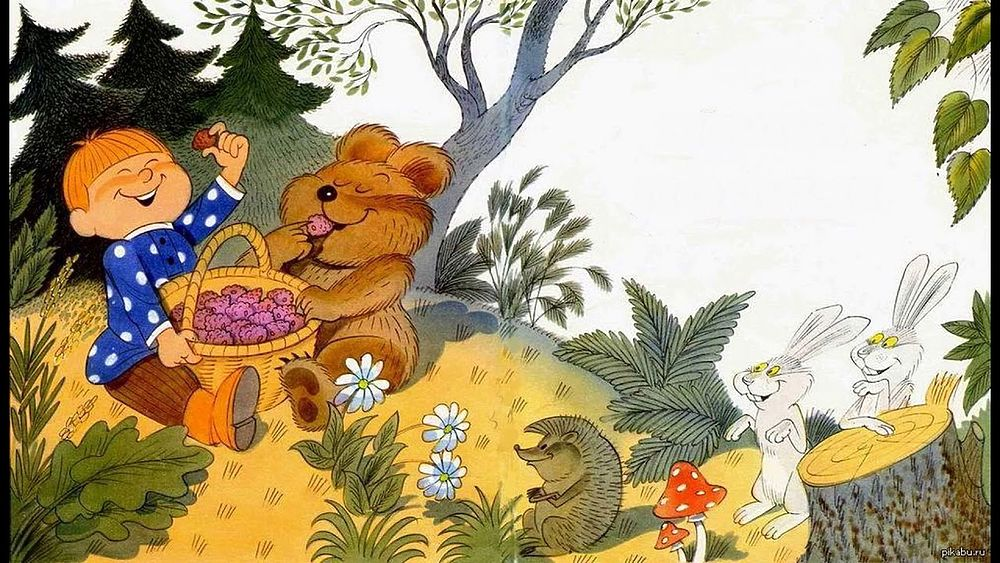
The work of Viktor Alexandrovich Chizhikov is familiar to almost everyone who grew up in the Russian speaking world. His drawings seem to live their own lives: warm, playful, filled with light and an inner sense of movement. It is no surprise that books illustrated by him were passed down in families from generation to generation for decades. Chizhikov created an entire world one wants to return to again and again, a world inhabited by cheerful animals, kindhearted characters, and the famous Olympic Bear whose smile became a symbol of an entire era.
The future artist was born in Moscow in 1935, and his first artistic experiments began almost in infancy. His parents allowed him to draw directly on the wall near his crib. It seems that this was when his natural desire to turn impressions into images first revealed itself. During the war, the family was forced to move to the countryside, where young Viktor started school and eagerly absorbed everything around him. His father, who served at the front, sent his son small drawings, precious and touching keepsakes that were carefully preserved by the family. After returning to Moscow, Chizhikov lived in a communal apartment, surrounded by voices, laughter, and constant movement. Perhaps this lively environment taught him to capture the character of people and animals at a single glance.
After finishing school, Chizhikov initially planned to study foreign languages, but fate led him to art. He worked for newspapers, studied at the Moscow Polygraphic Institute, and at one point showed his drawings to the legendary Kukryniksy, who immediately recognized his talent and helped him take his first professional steps. From that moment on, his artistic life gained momentum. Magazines, publishing houses, book series, and collaborations with beloved children’s writers followed. Chizhikov’s illustrations appeared everywhere, from Vesyolye Kartinki magazine to books by Boris Zakhoder, Eduard Uspensky, and Gianni Rodari.
Chizhikov had a rare ability to give each character a distinct personality. His figures seemed to speak through their facial expressions and poses, showing joy, surprise, shyness, or mischief. Even the smallest detail, a funny tuft of hair, a sly squint, or a catlike stretched paw, made a drawing feel alive. Cats were a particular favorite of the artist. He said that drawing them was pure pleasure, as every movement was graceful and their faces were always expressive. In books illustrated by Chizhikov, one can find entire armies of cats, each with its own unique charm.
However, Chizhikov’s greatest gift to the country was the Olympic Bear of 1980. Its kind eyes and simple yet incredibly warm design turned it into a true symbol of childhood for millions of people. Viewers’ voting chose this bear, and it has since become part of history. The artist later joked that the bear won not only because of sympathy, but also because a moose’s legs bend the wrong way for such an image.
Kindness was Chizhikov’s most important principle. He believed that an artist who draws for children cannot be an unkind person, because that would inevitably be reflected in their work. Kindness embedded in an illustration cannot be faked, which is why Chizhikov’s drawings remain so warm and, even years later, still bring smiles and a sense of childlike sincerity.
If you have a book on your shelf illustrated by Chizhikov, it is enough to simply turn its pages to feel that special atmosphere: cozy, lively, and filled with the heartfelt warmth that this remarkable artist so generously shared with his readers.