How a Child’s Eye Color Is Formed and Why It Can Change
While waiting for a child to be born, many parents wonder what their baby will be like and who they will resemble. One of the most common questions concerns eye color. Although overall appearance cannot be predicted, eye color can be explained to some extent from the perspective of biology and genetics. Several factors influence it at once, and the process is far more complex than it may seem at first glance.
Eye color is determined by the iris, which is located in front of the lens and regulates the amount of light entering the eye. Its shade is genetically determined and depends on information inherited from both parents. It was once believed that eye color was controlled by a single gene, but modern research has shown that dozens of genes are involved, each contributing to the final result.
The main role in eye color formation is played by the pigment melanin. The more melanin there is, the darker the eyes appear; with a smaller amount of pigment, the iris looks lighter. Other pigments also influence eye color, and in combination with melanin they can produce various shades, including green or hazel. It is the balance of these substances that determines the final eye color.
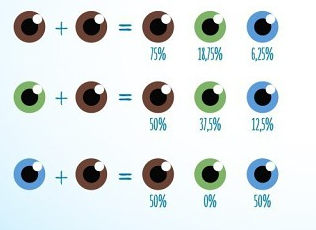
There is a widespread belief that dark eyes are a dominant trait while light eyes are recessive. In practice, however, the situation is much more complex. Eye color is not determined by a simple combination of two traits. Genes such as OCA2 and HERC2 play an important role. The first is responsible for melanin production, while the second regulates its activity. Depending on which variants of these genes are passed on to the child, their individual eye color is formed.
Eye color can change during the first years of life. Many children are born with light colored eyes because the pigment has not yet been evenly distributed. During the first year, and sometimes up to five or six years of age, the amount of melanin may increase, causing the eyes to darken. However, dramatic changes are unlikely. If the eyes are dark from the beginning, they will not become light later.
With age, eye color can also change slightly. In older people, the amount of pigment decreases, so the iris may sometimes appear lighter. In rare cases, changes in eye color are associated with eye diseases that disrupt the structure of the iris and impair vision.
Genetics remains a field where there is always room for surprises. A child may inherit their parents’ eye color or receive a completely different shade that appeared in distant relatives. It is the diversity of genetic combinations that makes every person unique.